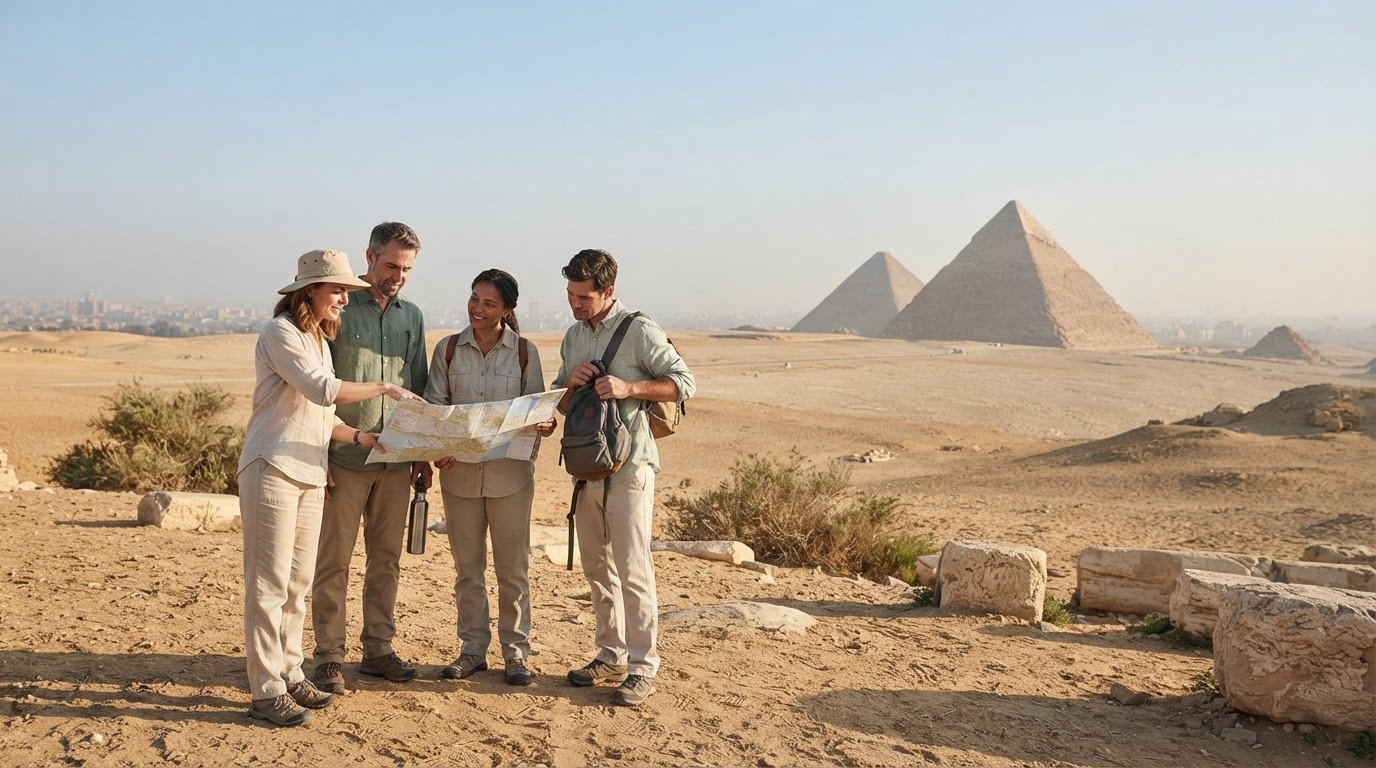
The coolest months aren’t always the quietest: December through February brings larger crowds to Egypt. For milder weather, plan your visit in October, November, March, or April. Comprehensive Cairo tour planning tips with Cairo Trips start with another simple choice: visit the Giza Pyramids early and allow plenty of time.
Choosing a season is only part of feeling prepared for your broader Egyptian journey. You’ll also need to decide how much time to allow for the pyramids, consider personal safety and health, and learn how to show respect for local customs.
This guide brings those decisions together in practical steps. Find seasonal guidance for choosing when to go, ways to plan a Giza visit around its scale and setting, and useful tips for navigating Egypt’s capital with greater ease and cultural awareness.
Key Takeaways
- Choose October, November, March, or April for milder weather, and weigh the cooler-season crowds against the summer heat when setting your dates.
- Plan an early start at Giza and leave enough time to explore the pyramid complex at an unhurried pace.
- Keep Egypt’s emergency numbers close: call 122 for police assistance and 123 for medical assistance.
- Build flexibility into Friday plans, since prayers around midday can affect opening hours at some Cairo attractions.
1. Best time to visit Cairo and seasonal weather
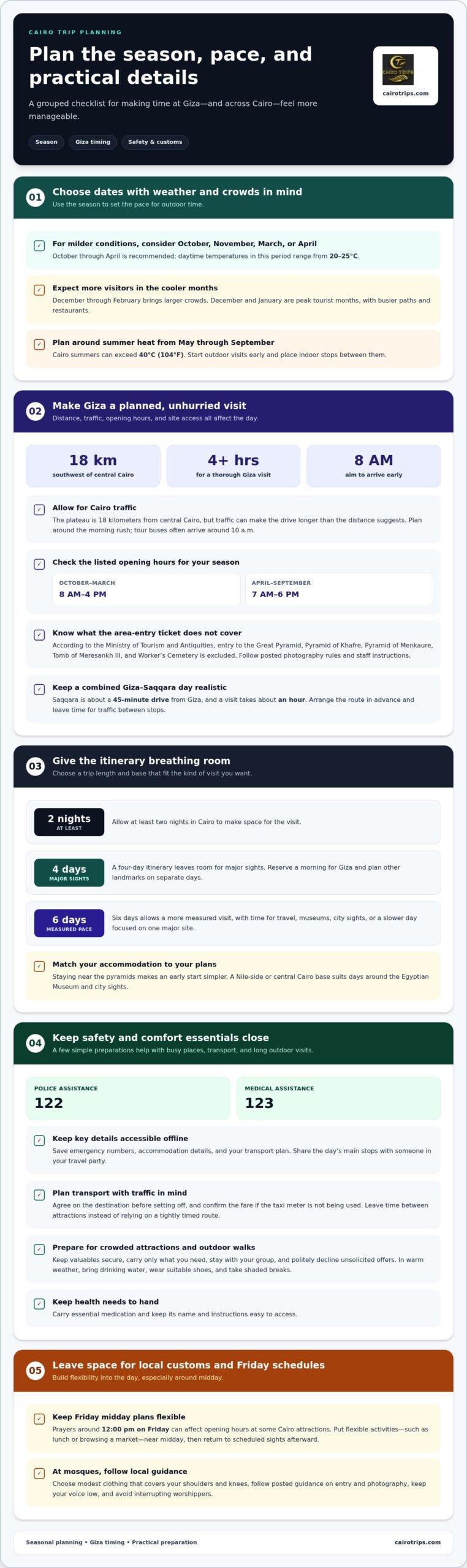
For balanced Cairo tour planning tips, start with October, November, March, or April. These months offer milder conditions for visiting Cairo. October through April is recommended, with daytime temperatures ranging from 20-25°C. December through February is mild too, but larger crowds gather around Cairo’s landmarks. December and January are peak tourist months, so expect busier paths and restaurants.
From May through September, Egypt can become extremely hot, especially in the south. Cairo summers can exceed 40 C (104 F), making extended outdoor visits demanding. In warmer months, start exploring outdoors early and place indoor stops between visits. October through April brings a cooler alternative, though seasonal crowds still shape the pace.
How many days do you need for a Cairo tour, and what itinerary works best? Allow at least two nights in Cairo. A four-day itinerary leaves room for major sights, while six days allows a more measured visit. Reserve a morning for the pyramids of Giza, then plan other landmarks on separate days.
The Giza Plateau lies 18 kilometers southwest of central Cairo, and a thorough visit takes at least four hours. Arriving early can help you avoid some of the day’s heat and crowds. Listed hours are 8 AM to 4 PM from October to March, and 7 AM to 6 PM from April to September. According to the Ministry of Tourism and Antiquities, area entry excludes the Great Pyramid, Pyramid of Khafre, Pyramid of Menkaure, Tomb of Meresankh III, and Worker’s Cemetery.
In warm weather, wear breathable clothes and a hat, and carry water around the plateau. At mosques, covering your shoulders and knees is a respectful choice. Local guides can help shape your day, and Egyptian restaurants offer a welcome pause between sights.
2. Giza Pyramids timing and distance from central Cairo
The Giza pyramid complex sits 18 kilometers southwest of central Cairo. Traffic can make the drive longer than the distance suggests, so plan your departure around the morning rush and aim to arrive at 8 a.m. Tour buses often arrive around 10 a.m. A thorough visit takes at least four hours, giving you time to explore the plateau rather than rush between viewpoints.
Opening hours vary by season: the complex is listed as open from 8 AM to 4 PM from October to March, and 7 AM to 6 PM from April to September. According to the Ministry of Tourism and Antiquities, the area-entry ticket does not cover entry to the Great Pyramid, Pyramid of Khafre, Pyramid of Menkaure, Tomb of Meresankh III, or Worker’s Cemetery. Photography rules can vary by site and area, so follow posted signs and staff instructions.
For a full day, pair the pyramids with Saqqara, not a long list of distant stops. Saqqara is about a 45-minute drive from Giza, and a visit there takes about an hour. Arrange the route in advance, allowing time for Cairo traffic between stops. For a closer look at the pyramids, local guides can add historical context and help structure your visit; choose one who can explain the sites in English if that suits you.
Must-see choices include the pyramids and Sphinx at Giza, Saqqara, and the Egyptian Museum. Set aside at least four hours for Giza and about an hour for Saqqara; leave the rest of the day for travel and a museum visit. For a slower day, focus on one major site and take time to appreciate its details.
Where you stay shapes the rhythm. Accommodation near the pyramids makes an early start simpler, while a Nile-side or central Cairo base suits days around the Egyptian Museum and city sights. For a guided visit focused on Giza, consider a Cairo Highlights itinerary.
3. Personal safety, health, and emergency contacts
For a more comfortable Cairo visit, plan transport, keep emergency contacts accessible, and stay alert in busy public places. Cairo traffic can be congested, so leave time between attractions rather than relying on a tightly timed route. Keep valuables secure and carry only what you need for the outing.
Save Egypt’s emergency numbers before you leave your accommodation. Call 122 for police assistance and 123 for medical assistance. Keep the numbers accessible offline, and share your day’s main stops with someone in your travel party. If an emergency occurs, move to a safe public place when possible, then contact the appropriate service with your location and a clear description of what happened.
For ground transport, agree on the destination before setting off and confirm the fare if the taxi meter isn’t being used. Cairo traffic can change journey times, so avoid scheduling a distant appointment immediately after a cross-city trip. For a visit to Alexandria or another destination beyond Cairo, plan the travel day around the route rather than squeezing in several stops.
Take the same steady approach at crowded attractions. Keep your phone and wallet secure, stay with your group in busy areas, and politely decline unsolicited offers that interrupt your plans. If you hire a guide, agree on the visit’s focus before you begin. A guide who explains ancient sites or Cairo’s history can make the day easier to follow.
Heat and long walks can affect comfort, especially during an October visit to an outdoor site. Carry drinking water, wear suitable shoes, and take breaks in shaded areas. If you have health needs, keep essential medication with you and note its name and instructions. Keep accommodation details, emergency contacts, and the day’s transport plan easy to access, even without an internet connection.
4. Cultural customs and Friday prayer schedules
Build Friday prayer time into your Cairo itinerary before arranging museum visits or long walks. Prayers around 12:00 pm on Friday can affect opening hours at some Cairo attractions, so place flexible activities near midday. For example, enjoy lunch or browse a market, then return to scheduled sights afterward. This small adjustment helps your arrival times feel less rushed and leaves room for the changing rhythm of the city.
At a mosque, choose modest clothing and follow posted guidance on entry and photography. Keep your voice low, avoid interrupting worshippers, and ask before photographing people. At museums and historic sites, follow staff instructions and signs, especially around displays and prayer areas. These courtesies show respect while letting you appreciate Cairo’s architecture, daily life, and layered history at a comfortable pace.
Use Egyptian pounds for small purchases and service tips. One Egyptian pound is described as roughly 2 U.S. cents, while visitors may be expected to tip from 20 Egyptian pounds up to 200 Egyptian pounds for some services. The appropriate amount depends on the service, so carry smaller notes and offer a tip discreetly. A warm “shukran,” meaning thank you, is a gracious way to acknowledge help.
For everyday exchanges, a few Arabic words can make a friendly difference. Say “min fadlak” when asking a man politely, or “min fadlik” when addressing a woman; use “shukran” to say thanks. In a restaurant, greet staff courteously and clarify your order before settling the bill. Around the Nile River or Cairo’s busy sights, patience and a calm tone help keep conversations pleasant. For a culturally attentive walk among historic sights, plan a guided visit through Historic Cairo.
Cairo Trips: Egypt Beyond Cairo
When you’re ready to explore beyond the capital, Cairo Trips’ Egypt Beyond Cairo trips bring Luxor, Aswan, and the Red Sea into view, helping you shape a journey around the places that interest you most. For an evening along the Nile, Nile Cruises pair dinner with music, food, and city lights.
For more time in the capital, Cairo Highlights includes visits to the Pyramids, Sphinx, and Egyptian Museum with an expert local guide. Historic Cairo explores Islamic Cairo, Khan el-Khalili, and historic mosques. Local insight and expert guides add context as you move between landmarks and neighborhoods. Choose the experience that fits your trip, then contact Cairo Trips to discuss your plans.
Let your Cairo plans open into a wider journey
The most memorable itineraries leave room for more than a checklist. As you plan, think about the experiences you want to carry home: a quiet stretch on the Nile, time among Cairo’s historic neighborhoods, or a journey beyond the capital. Cairo Trips offers Egypt Beyond Cairo, Nile Cruises, and Historic Cairo to help you build those interests into your travels.
Start with one clear choice: stay close to Cairo’s historic streets, follow the river, or venture farther into Egypt. Let these Cairo tour planning tips guide your decision, then shape each day around your own pace and curiosity.
Contact Cairo Trips to plan your visit, and take the next step toward a journey that feels distinctly yours.
Frequently Asked Questions
When is the best time of year and time of day to visit Cairo?
October, November, March, and April generally bring milder weather for Cairo sightseeing. Start outdoor visits early, then use the hottest part of the day for an indoor stop, such as a museum or a leisurely meal. December through February is also mild, though popular sites can feel busier. This balance gives you flexibility when combining outdoor landmarks with time in the city.
How much do Cairo tours, attraction tickets, and guide services cost?
Costs depend on the attractions you choose, what each ticket covers, and the kind of guiding you want. For a guided itinerary, the price depends on the selected sites, guide service, and itinerary scope, and is provided after a quote request. Budget for admission separately: entry to a site and access to particular monuments may require different tickets.
Should you book a private guide, group tour, or plan Cairo sightseeing independently?
Choose the option that matches how much structure and context you want. A private guide suits travelers who prefer a flexible pace or have particular interests; a group tour follows a set route with shared commentary. Independent sightseeing offers more freedom, but you’ll handle navigation and timing yourself. For a history-focused visit, an expert local guide can connect landmarks with their stories.
How do you get around Cairo, including airport transfers, taxis, ride-hailing apps, and the metro?
Cairo’s metro is useful for some city journeys, while road traffic can slow taxis and app-based rides. From the airport, compare available transport options, confirm pickup details for an app ride, and allow extra time if your route crosses the city.
What should tourists wear and know about local customs, tipping, and bargaining in Cairo?
For mosque visits, choose clothing that covers your shoulders and knees, and follow signs or staff guidance. Tipping expectations vary by service, so keep smaller Egyptian-pound notes handy and offer gratuities discreetly. Bargaining may be part of buying souvenirs or agreeing on a taxi fare when the meter isn’t used; settle on the amount calmly before the journey or purchase. A simple “shukran,” meaning thank you, is a courteous gesture.


[…] says most criminal acts are crimes of opportunity, including purse snatching and pickpocketing. Keep valuables secure and hotel doors locked, as the CDC […]