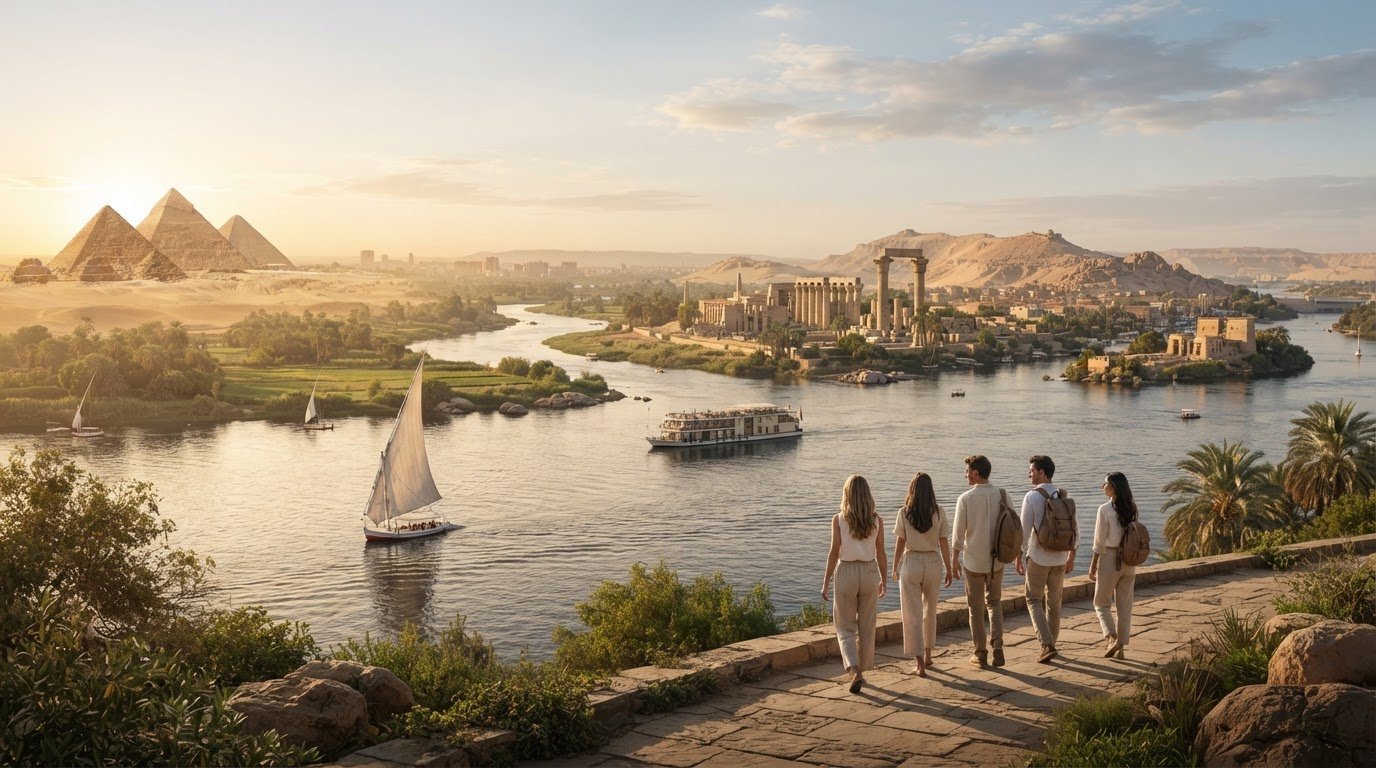
A week is a useful starting point, but nine days gives Cairo, Luxor, and Aswan more room to unfold. For Cairo to Luxor and Aswan trip planning, aim for seven to nine days; four to six days can cover all three, but the pace will feel rushed.
It’s natural to want to see the pyramids, explore ancient temples, and experience the Nile without spending every day in transit. A good itinerary balances time in each destination with the journeys between them, leaving you time to enjoy the sights rather than simply tick them off.
This guide explains how long to spend in Cairo, Luxor, and Aswan, what a combined sightseeing and cruise itinerary can include, and how season, transport, and group size affect costs. You’ll also find ways to make a shorter visit work, decide whether extra days are worthwhile, and plan a route through Egypt.
Key Takeaways
- Shape your itinerary around the pace you want: a compact visit means choosing priorities, while extra days leave more room for temples and time on the Nile.
- Compare combined sightseeing and cruise itineraries by what they include, such as Cairo highlights, stops along the river, and time in Luxor and Aswan.
- Choose transport with both journey time and sightseeing energy in mind; a faster connection can preserve more time at your destinations.
- Season and group size can affect tour costs, so compare options using your travel dates and the number of people in your party.
- Plan for Egypt’s warmer conditions with breathable clothing, and choose modest attire for temple visits.
How many days do you need in Cairo, Aswan & Luxor?
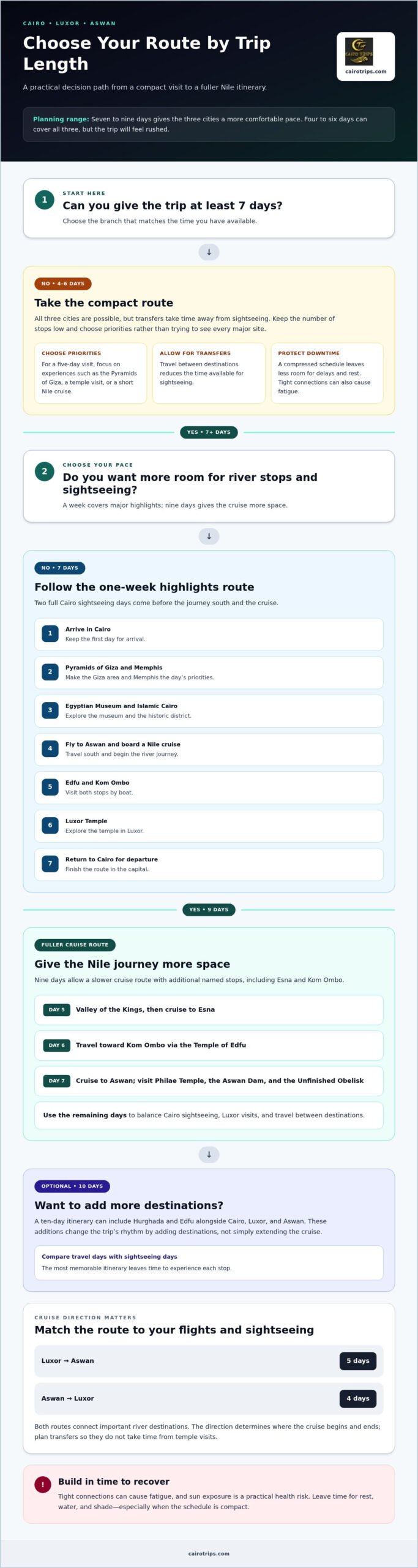
Seven to nine days gives Cairo, Aswan, and Luxor a more comfortable pace; four to six days is possible but rushed. With five days, prioritize the three cities; seven days allows room for a Nile cruise, while ten can include Hurghada and Edfu. Tight connections can cause fatigue, and sun exposure is a practical health risk, so leave time for rest, water, and shade.
Short Itineraries for Limited Time
A five-day itinerary can cover Cairo, Luxor, and Aswan, but transfers take time away from sightseeing. Decide which experiences matter most, such as the Pyramids of Giza, a temple visit, or a short Nile cruise, then build the route around them. Limit the number of stops, since a compressed schedule leaves less time for delays and rest.
Four to six days can work if your time is limited, though the pace will feel rushed. With five days, choose a focused route instead of trying to see every major site. Seven days gives you more breathing room, while nine allows time for river stops and a fuller itinerary.
One-Week Cairo and Nile Cruise Plan
A one-week plan can begin with arrival in Cairo on Day 1, followed by the Pyramids of Giza and Memphis on Day 2. On Day 3, visit the Egyptian Museum and Islamic Cairo. This sequence gives the capital two full sightseeing days before the journey south.
On Day 4, fly to Aswan and board a Nile cruise. Visit Edfu and Kom Ombo by boat on Day 5, then explore Luxor Temple on Day 6. Day 7 returns to Cairo for departure. This route links major landmarks with river travel, although each day has a clear priority.
Nine-Day Route Through Esna and Kom Ombo
Nine days allow a slower cruise route with more named stops. On Day 5, explore the Valley of the Kings before cruising to Esna. The next day, travel toward Kom Ombo via the Temple of Edfu, connecting two significant temple visits within the river journey.
On Day 7, cruise to Aswan and visit Philae Temple, the Aswan Dam, and the Unfinished Obelisk. Use the remaining days to balance Cairo sightseeing, Luxor visits, and travel between destinations. Compared with a one-week itinerary, this version gives the cruise more space for Esna and Kom Ombo.
Luxor-to-Aswan Cruise Itineraries
A recommended Luxor-to-Aswan Nile cruise lasts five days, while the reverse Aswan-to-Luxor route lasts four. Both connect important river destinations, but the direction determines where the cruise begins and ends. Match the route to your flights and sightseeing plans so transfers don’t take time from temple visits.
A ten-day itinerary can include Hurghada and Edfu alongside Cairo, Luxor, and Aswan. These additional stops change the trip’s rhythm, adding destinations rather than simply extending the cruise. Compare travel days with sightseeing days before choosing. The most memorable itinerary leaves time to experience each stop.
Tours combining Cairo sightseeing and Nile cruises
Prioritize the Pyramids of Giza, Philae Temple, and Luxor’s Valley of the Kings, then add other sights at a pace that suits you. Budget for admission to each attraction separately; the total depends on the sites and ticket options in your itinerary.
Combined tours can bring Cairo’s pyramids together with ancient temples and a Nile cruise. The eight-day Wonderful of Egypt tour combines Cairo sightseeing with a cruise between Luxor and Aswan. The eight-day Ultimate Egypt Holiday is another example. Compare itineraries by the time allowed for each visit, not just the number of landmarks listed.
At Giza, arrive by 9:00 AM to avoid larger crowds, then allow 2-3 hours for the pyramid complex. The Great Pyramid and Sphinx make a natural first focus. Later, pair the Egyptian Museum with a walk through Islamic Cairo, or reserve separate time for each. The Egyptian Museum in Tahrir Square holds over 120,000 artifacts, so a focused visit of 1.5-2 hours helps keep the day manageable.
Ancient sites beyond central Cairo can add depth, but they also change the day’s travel pattern. Memphis, founded around 3100 BC by King Menes, and Saqqara’s 4,700-year-old Step Pyramid offer a distinct contrast to Giza. Choose these as a dedicated excursion rather than squeezing them between museum visits. A nine-day Golden Sands & Sacred Nile tour adds the White Desert to pyramids and a Nile cruise, illustrating how extra destinations reshape the itinerary.
In Aswan, group Philae Temple, the Aswan Dam, and the Unfinished Obelisk into one sightseeing sequence. The recommended visit time for Philae is 1-2 hours. In Luxor, begin with the East Bank and Luxor Temple, then set aside another visit for the West Bank and Valley of the Kings. This order separates the city’s riverfront monuments from the tombs across the Nile.
Luxor Temple dates to 1400 BCE, while the Valley of the Kings contains 63 tombs. Those landmarks reward unhurried visits, so avoid planning several distant sites in a single tight block. A combined itinerary works best when Cairo’s highlights come before the cruise, and Luxor and Aswan visits follow the ship’s route. The sites you select, along with ticket options and visit timing, determine the attraction-fee allowance to build into your travel budget.
Make the Valley of the Kings and Philae Temple priorities, then add Luxor Temple, the Aswan Dam, and the Unfinished Obelisk if time allows. Budget for admission to each attraction separately; the total depends on the sites and ticket options you choose.
Egypt travel timing, transport, currency, and dress
October to April is recommended for pleasant weather, while your transport choices affect each day’s pace. Egypt’s currency is the Egyptian pound.
Choosing Transport by Budget and Schedule
Choose transport by weighing journey time against the hours you want for temples and museums. A flight saves time between Cairo and southern Egypt, while a day train makes the overland journey part of the experience. In Luxor and Aswan, local guides can add context to ancient history and help organize visits.
Pack light, breathable clothes for warm days, and choose modest attire for temple visits. This practical combination suits long sightseeing days and makes it easier to move between outdoor sites and museums.
Domestic Flights and Airport Transfers
A flight from Cairo to Luxor takes about 1 hour 10 minutes, while Cairo to Aswan takes about 1 hour 30 minutes. Compare departure times with your sightseeing plans, since airport journeys and waiting time also occupy part of the day.
Plan the ground connection between each airport, hotel, station, or cruise departure point as a separate part of your route. Leave enough time between a flight and a scheduled visit, especially if you’re heading straight to a temple or museum.
Flight and First-Class Train Transfers
To book regular or sleeper trains, select the Cairo-Luxor or Cairo-Aswan route, travel date, and seat or cabin type through a railway booking channel. Ticket conditions vary by service and fare, so keep your issued ticket and follow its stated conditions.
Day trains take around 9-10 hours from Cairo to Luxor and 12-13 hours to Aswan.
Transport Costs and Journey Times
Compare the full journey, not only the ticket price.
A scenic train from Luxor to Aswan takes about 3.5 hours. For Abu Simbel, the drive from Aswan takes about 3 hours each way. Add those travel blocks before setting temple visits, and carry Egyptian pounds for local expenses. A route that matches transport to sightseeing time can leave more of the day for Egypt’s history.
Tour pricing by group size and season
Tour budgets depend on travel dates, group size, room occupancy, and itinerary inclusions. Accommodation packages distinguish May through August from September through April, reflecting seasonal differences in demand. A trip linking Cairo, Karnak, and a Nile River cruise may also involve different transfers and sightseeing arrangements. Compare these details to choose an itinerary that fits your priorities.
Group size changes how a per-person tour quote is calculated. Published tiers for May through September 2026 distinguish groups of 2-4, 5-8, and 9-16 people. Those brackets illustrate why the same route can have different per-person pricing for a couple, a family group, or a larger party. Ask for the price that applies to your dates and group, rather than treating a broad starting figure as a personal budget.
Room occupancy affects how accommodation costs are shared. A triple room places three travelers in one room, while a private room assigns the room to one traveler. Compare room arrangements alongside the tour’s inclusions. If you’re traveling alone, your room choice can affect your per-person total more than it would for travelers sharing.
Season matters even when the route stays the same. Accommodation packages distinguish May through August from September through April, so compare the periods that match your planned Nile River journey. Demand, room type, and itinerary inclusions all shape the quote. For a specific tour, the price depends on travel dates, group size, room occupancy, inclusions, and transfer arrangements; the price is provided after a quote request.
Child rates depend on age and room-sharing terms. In the stated package policy, children aged 2 to 5.99 years pay 25% of the tour price when sharing a room with their parents. Children aged 6 to 11.99 years pay 50% under that same arrangement. Travelers aged 12 years and older pay the full adult tour price.
Before finalizing your budget, compare what the itinerary includes around Luxor and Aswan. A route featuring Karnak, river travel, and transfers may allocate costs differently from one focused on Cairo sightseeing. Review the room basis, group bracket, seasonal period, and child policy together. These details make it easier to compare options consistently and account for transfers and accommodation.
Recommended trip length for Cairo, Aswan, and Luxor
Seven to nine days is a practical target for Cairo, Aswan, and Luxor. Four to six days can cover all three destinations, but the pace will feel rushed. Choose your trip length based on the balance you want between Cairo’s landmarks, temple visits, and time aboard a Nile cruise. With ten or more days, you can add stops instead of compressing each visit. Good Cairo to Luxor and Aswan trip planning starts with the pace you want, not simply a list of sights.
Five days: Keep the route focused. Prioritize the Pyramids of Giza and Sphinx, then choose a small number of major sites in Luxor and Aswan. A five-day itinerary covering all three cities leaves limited time for transfers and sightseeing. Rather than treating every famous temple as essential, choose the places that matter most to you and plan the rest of the route around them.
Seven days: A one-week itinerary can begin with arrival in Cairo on Day 1. Visit the Pyramids of Giza and Memphis on Day 2, then the Egyptian Museum and Islamic Cairo on Day 3. On Day 4, fly to Aswan and board a Nile cruise. Visit Edfu and Kom Ombo by boat on Day 5, explore Luxor Temple on Day 6, then fly to Cairo and depart on Day 7.
Nine days: Extra time gives the cruise a fuller route. On Day 5, explore the Valley of the Kings and cruise to Esna. On Day 6, travel toward Kom Ombo via the Temple of Edfu. Day 7 brings the cruise to Aswan, with visits to Philae Temple, the Aswan Dam, and the Unfinished Obelisk. This itinerary suits travelers who want additional river stops without adding a separate region.
Ten days: Travelers with ten or more days often add destinations. Hurghada and Edfu are examples that extend the journey beyond the Cairo, Luxor, and Aswan core. Choose an extra stop that suits your interests, while protecting enough time for the principal sights. In Luxor, you might pair Karnak Temple with Luxor Temple; in Aswan, prioritize Philae Temple or Abu Simbel.
For a first visit, seven days offers a clear route through Cairo and the Nile corridor; nine days allows a more considered cruise itinerary. A four- to six-day trip is best treated as a highlights visit, not a leisurely tour. For Cairo to Luxor and Aswan trip planning, shape the route around the places you most want to experience. Plan a route through Egypt around your available days and interests.
Cairo Trips: Egypt Beyond Cairo
Cairo Trips helps travelers plan journeys from Cairo to Luxor and Aswan through Egypt Beyond Cairo and Nile Cruises. Choose these experiences when you want a thoughtfully planned route beyond the capital, with expert local guides adding context to ancient sites along the way.
In the capital, Cairo Highlights includes visits to the Pyramids, Sphinx, and Egyptian Museum, while Historic Cairo explores Islamic Cairo, Khan el-Khalili, and historic mosques. These experiences can complement a southern itinerary, whether you begin among Cairo’s landmarks or extend your journey beyond them.
To discuss a route that suits your interests, contact Cairo Trips or visit cairotrips.com.
Let your Egypt itinerary take shape
The most memorable journeys leave room for your own interests, whether you’re drawn to quiet moments on the Nile or the layered streets of Cairo. Thoughtful Cairo to Luxor and Aswan trip planning is about more than fitting landmarks into a schedule; it’s about shaping a route that feels connected from the first day to the last.
Cairo Trips can help bring your plans into focus with Egypt Beyond Cairo, Nile Cruises, and Historic Cairo. Share what you hope to experience and decide how the capital and southern destinations fit into your journey. A clear starting point makes it easier to turn ideas into a considered travel plan.
Contact Cairo Trips to plan your trip, and take the next step toward an Egypt journey shaped around what matters to you.
Frequently Asked Questions
What are the best ways to travel from Cairo to Luxor and Aswan: flight, train, or bus?
A flight suits travelers who want to save time, while trains and buses offer overland alternatives. Choose a flight to preserve more daylight for sightseeing, or a train if the rail journey fits your schedule. Buses are another option, but a long ride may take time away from visits. For a Luxor-to-Aswan connection, a scenic train ride is one overland choice. Compare departure times with your first planned activity.
How long does it take to travel from Cairo to Luxor and from Luxor to Aswan?
A Cairo-to-Luxor flight takes about 1 hour 10 minutes; the day train takes around 9-10 hours. Cairo-to-Luxor buses often take 11-14 hours. From Luxor to Aswan, a scenic train ride takes about 3.5 hours. Allow additional time around any station or airport connection, and avoid placing a timed temple visit immediately after a long overland journey.
What are current flight, train, and bus ticket prices for Cairo-Luxor-Aswan?
Treat these as transport costs, not a full trip budget: your route, chosen service, and ticket class affect the total.
Is a Nile cruise between Luxor and Aswan worth it, and how do cruise prices compare?
A Nile cruise can be worthwhile if you want the river journey and sightseeing stops to be part of the experience, rather than arranging every connection separately. Compare cruise options by their inclusions, such as meals, guided visits, transport, and entry tickets. Then weigh those details against your preferred pace and the cost of arranging transport and visits individually. The right fit depends on what you want included.
When is the best time of year to visit Luxor and Aswan, considering weather and crowds?
October to April is recommended for pleasant weather in Egypt. Crowd levels can differ between sites and visiting times, so plan popular stops with care. At the Pyramids of Giza, arriving by 9:00 AM is advised to avoid larger crowds. In Luxor and Aswan, schedule outdoor temple visits early in your day, leaving room to adjust the order of stops around your travel connections.
Which Luxor and Aswan attractions should travelers prioritize, and what are current entrance fees?
Prioritize the Valley of the Kings and Philae Temple, then add Luxor Temple, the Aswan Dam, and the Unfinished Obelisk if time allows. Budget for admission to each attraction separately; the total depends on the sites and ticket options you choose.
What are the safety, health, and travel risks when visiting Luxor and Aswan?
Tight connections can cause fatigue, and sun exposure is a practical health risk. Leave time for rest, water, and shade, and allow space between flights and scheduled visits.




[…] Allow 10 days to 2 weeks for Cairo, Luxor, and Aswan, a practical span for travelers who want time in each place. Use the Cairo days for the Egyptian Museum and the city’s major historic sights. Then dedicate the southern part of the itinerary to Luxor and Aswan, where distances between temples and river visits shape the day. Add Abu Simbel only after deciding how much travel time you want beyond Aswan. […]